
Córdoba is one of the most visited day trip destinations in Andalusia and one of the most underestimated overnight stops. Most travelers arrive by train from Seville or Málaga in the morning, spend a few hours at the Mezquita-Catedral, walk across the Roman Bridge, and head back to their hotel on the coast before dinner. It is a perfectly reasonable way to see the highlights. It is also a significantly diminished version of what Córdoba actually offers, and we are happy to provide you with this comprehensive Cordoba Spain Travel Guide.
We built an overnight stay into our recent Andalusia itinerary and by the time we were sitting by the Roman ruins with a drink in the quiet of a Tuesday evening, long after the day visitors had gone, it was obvious that this was the right call. Here is the full guide to doing Córdoba properly, whether you have a day or two nights.
THE ROAD TO CÓRDOBA
If you are driving to Córdoba from Granada, the route through Alcalá la Real is worth taking over the faster highway option. We stopped at the Fortress of La Mota in Alcalá la Real, a medieval fortified town sitting on a hilltop that is almost entirely open to explore with almost nobody else around.
The bases of the homes, the tavern, the floor designs still intact with stone sides standing, a tavern cellar with cracked wine barrel pottery still sitting in it. The medieval bodega where the wine was made, with the slanted floor, the pressing holes, and the storage cellar all completely accessible. It is one of the most unexpectedly extraordinary sites we encountered on the entire trip and it is completely free. If you are driving between Granada and Córdoba, stop there. It takes about an hour and it will stay with you.
We also had lunch at Restaurante Nicols in Luque, a converted train station restaurant along the same route. Jamón y queso bocadillo, a tinto de verano, a small beer. Simple, good, exactly right for a midday stop between cities.
THE MEZQUITA-CATEDRAL
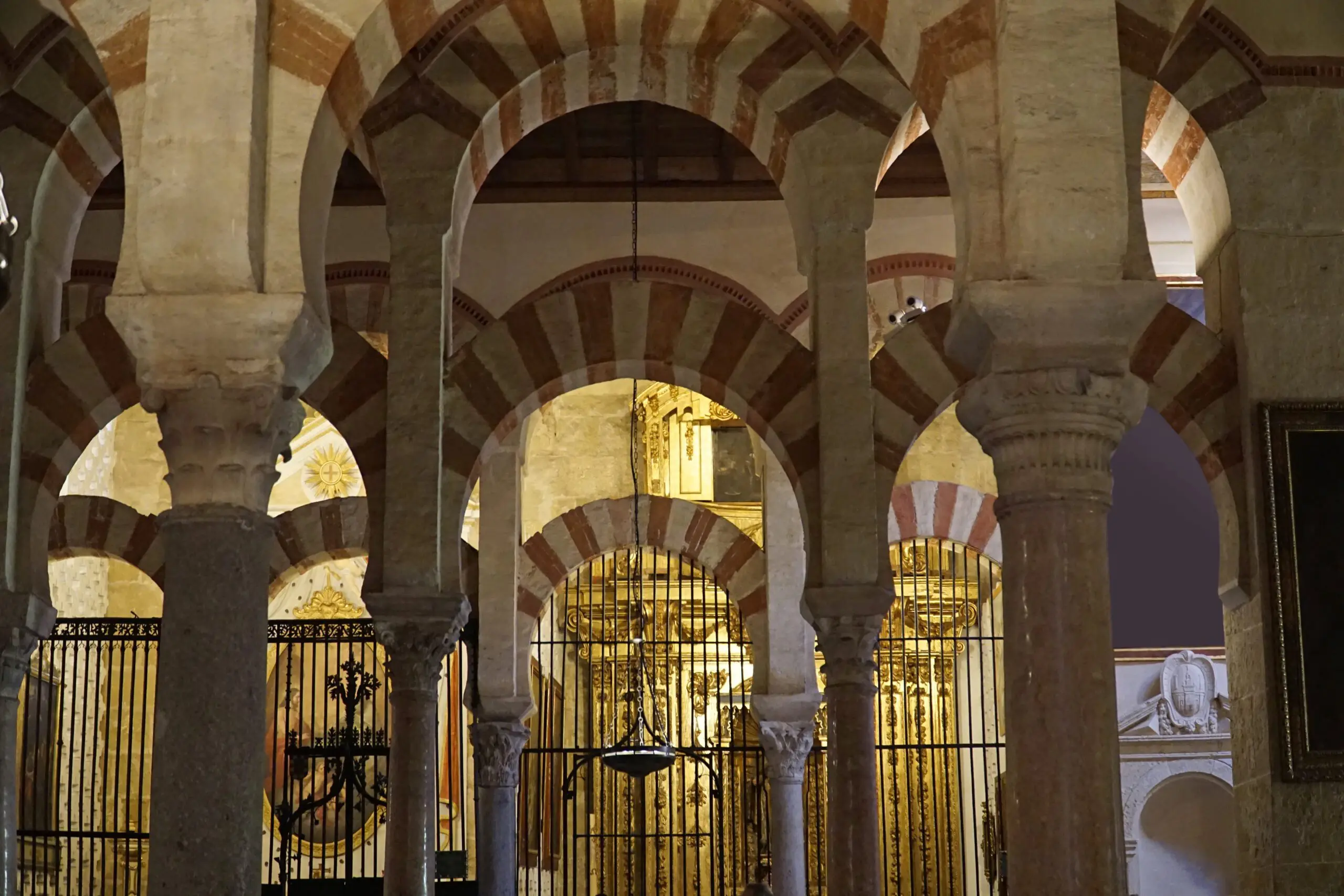
There is no way to adequately prepare someone for the interior of the Mezquita-Catedral. You can look at photographs for years, read the history, understand intellectually what you are about to see, and still be stopped in your tracks when you walk through the doors.
The forest of red and white striped arches stretches as far as you can see in every direction. Hundreds of columns, originally sourced from Roman and Visigothic buildings throughout the region, supporting double-tiered horseshoe arches in alternating stone and brick. The geometry of it is hypnotic. The scale is hard to process. You find yourself walking slowly and stopping repeatedly, looking down the length of a corridor of arches and then turning to find another one extending in a different direction.
Building began under Abd al-Rahman I in 784 AD on the site of a Visigothic church. It was expanded multiple times over the following centuries by successive rulers, each addition more elaborate than the last, until the Mezquita became one of the largest and most magnificent mosques in the Islamic world.
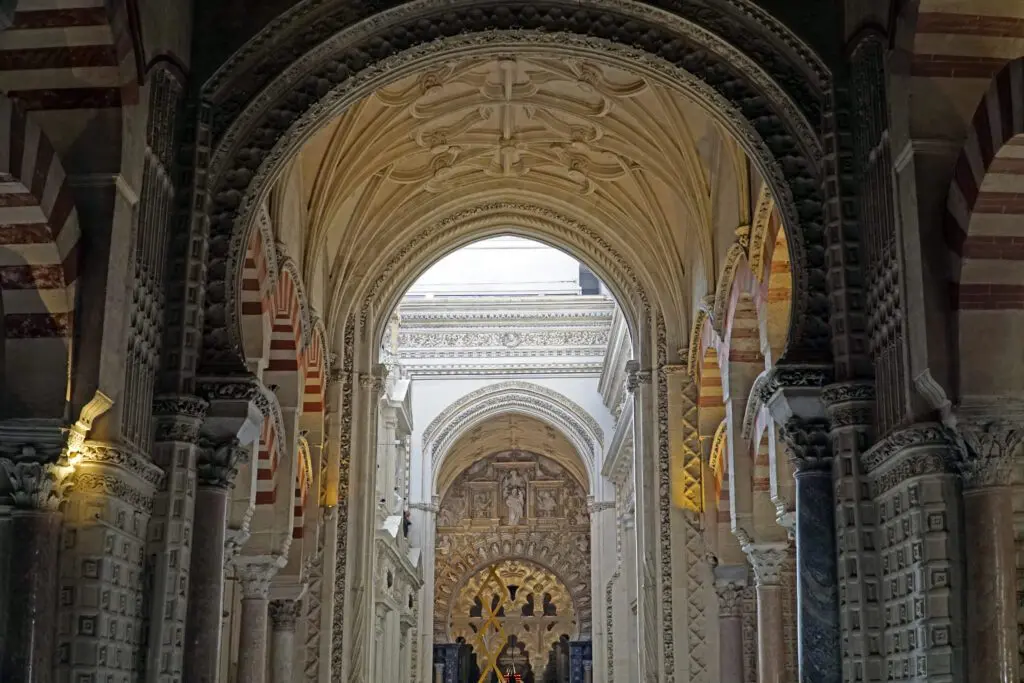
After the Christian reconquest of Córdoba in 1236, the building was consecrated as a cathedral. In the 16th century, a full Gothic and Renaissance cathedral nave was constructed directly in the center of the mosque, with the permission of Charles V and over the fierce objections of the Córdoba city council. When Charles V reportedly saw the completed result, he is said to have remarked that the builders had destroyed something unique to build something ordinary. Whether the quote is accurate or apocryphal, we get the sentiment.
Standing inside the Mezquita today, you encounter both buildings simultaneously. The cathedral nave rises in the center, surrounded on all sides by the mosque that predates it by centuries. It is a jarring, uncomfortable juxtaposition, much as we felt at the Alhambra in Granada. The art that was added is not without merit. But the original is extraordinary, and the imposition of the cathedral onto it carries a weight that stays with you after you leave.
We did a guided tour of the Mosque-Cathedral and we’re not sure that we recommend it. We were timed as to how long we could be there and weren’t permitted to explore on our own. I think this one is best done on your own with the included audio tour (don’t forget those earbuds!). The context for each section of the building, the history of each expansion, the specific story of the cathedral insertion: none of it is obvious from the architecture alone and all of it changes how you understand what you are looking at. Walking through without context means missing most of what makes this building extraordinary.
THE JEWISH QUARTER AND CALLE DE LAS FLORES
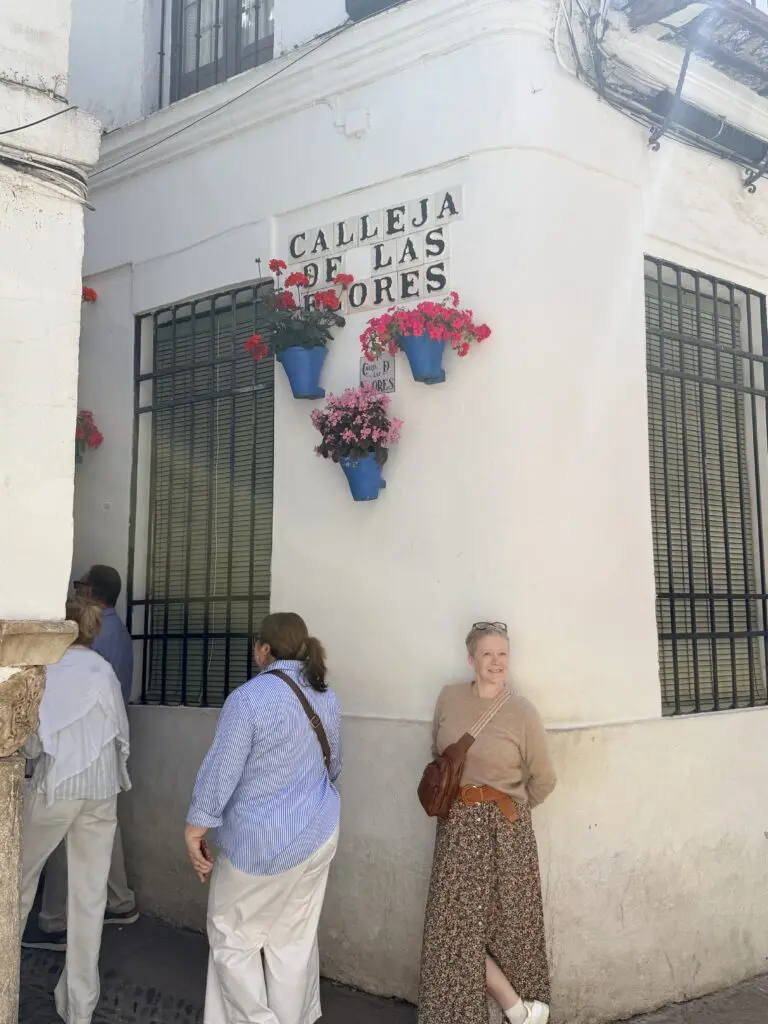
The Jewish Quarter surrounding the Mezquita is one of the most atmospheric neighborhoods in Andalusia. Narrow whitewashed lanes, flower-filled window boxes, small plazas, and the occasional glimpse of a private courtyard through an open gate. Córdoba takes its courtyard culture seriously and the annual Patios Festival, usually held in May, opens private courtyards across the city to visitors. If your dates overlap with the festival, it is worth building your itinerary around it.
Calle de las Flores is the most photographed street in Córdoba and possibly in all of Andalusia. A narrow lane lined with flower pots against whitewashed walls, with the Mezquita bell tower visible at the end of the street. It is exactly as beautiful as every photograph suggests and it is worth going at different times of day to see it in different light.
THE ROMAN BRIDGE
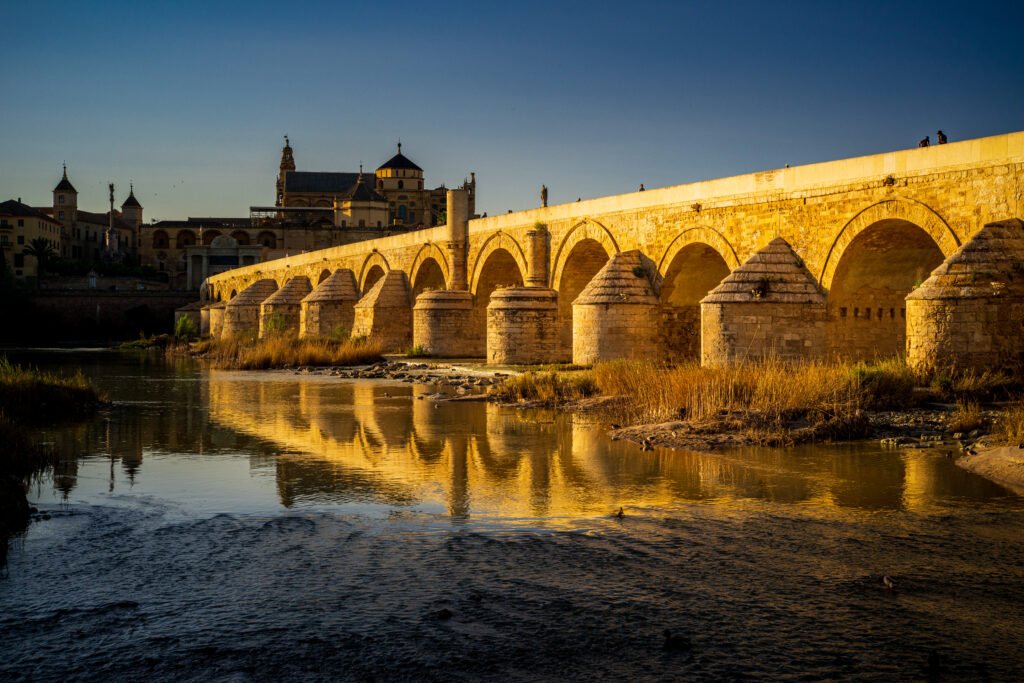
The Puente Romano crosses the Guadalquivir River directly in front of the Mezquita and dates to the first century BC, though it has been rebuilt and restored multiple times over the intervening two millennia. Walking across it in the evening, with the Mezquita tower illuminated on one side and the Torre de la Calahorra fortified gate on the other, is one of those simple travel experiences that does not require any context to appreciate.
We ended our afternoon sitting next to the Roman ruins near the bridge with a drink. The day visitors were gone. The streets had quieted. The city felt entirely different from what it had been at midday when the tour groups were moving through. That shift is exactly why the overnight stay argument is so compelling.
THE CASE FOR STAYING OVERNIGHT
As a day trip from Málaga or Seville, Córdoba gives you the Mezquita, the Jewish Quarter, the Roman Bridge, and the Calle de las Flores. That is a full and worthwhile day and if your itinerary genuinely cannot accommodate an overnight there is no reason to feel you have missed the essential experience.
But as an overnight stay, Córdoba gives you all of that, plus the city after the day-trippers have left. The evening light on the Mezquita. The Roman Bridge at dusk. The Jewish Quarter at night when it is quiet enough to actually hear yourself think. Dinner without having to compete with tour groups for a table was a plus. A morning before the crowds arrive, *chef’s kiss*.
We stayed at a hotel about 10 minutes from the Mezquita entrance. Waking up and walking to the building before the first tour buses arrived was a genuinely different experience from any midday visit. The early-morning light inside the Mezquita, before the main visitor crowds arrive, is something a day tripper simply cannot access.
THE DAY TRIP CASE
If a day trip is what your schedule allows, here is how to make the most of it. Take the early train from either Seville or Málaga. The AVE high-speed train from Málaga takes just under two hours. From Seville, it is about 45 minutes. Arrive by 9 am, go straight to the Mezquita before the midday crowds build, walk the Jewish Quarter and Calle de las Flores before lunch, have lunch at one of the restaurants near the Roman Bridge, cross the bridge in the afternoon, and take the early evening train back. That is a full and satisfying day.
Book your Mezquita ticket well in advance. The timed entry system means walk-up availability can be limited in peak season.
PRACTICAL TIPS BEFORE YOU GO
- Book a guided tour of the Mezquita-Catedral in advance. The history is the experience and a good guide delivers it.
- Stay at a hotel close to the Mezquita if you are staying overnight. The walking access to the main sites transforms the visit.
- The Calle de las Flores is best in the morning before the tour groups arrive and in the late afternoon when the light is good.
- The Roman Bridge at dusk is worth timing your day around.
- If you are driving from Granada, the route through Alcalá la Real and the Fortress of La Mota adds time but totally worth it.
Córdoba is one of the great cities of the medieval world and one of the most rewarding destinations in modern Andalusia. The Mezquita-Catedral alone is worth the journey from anywhere in Spain. Everything else, the Jewish Quarter, the Roman Bridge, the city after dark, the morning before the crowds, makes the case for staying longer than most itineraries allow.
If you are building an Andalusia itinerary and want help fitting Córdoba in properly alongside Seville, Gibraltar, Málaga, and Granada, that is exactly what we do at THK Travel Advisors. Every itinerary is completely tailor-made. Reach out at thktravel.com or call us at 408-781-6966 and let’s start planning your journey.